
When Menopause Comes Faster Than Expected After Hysterectomy
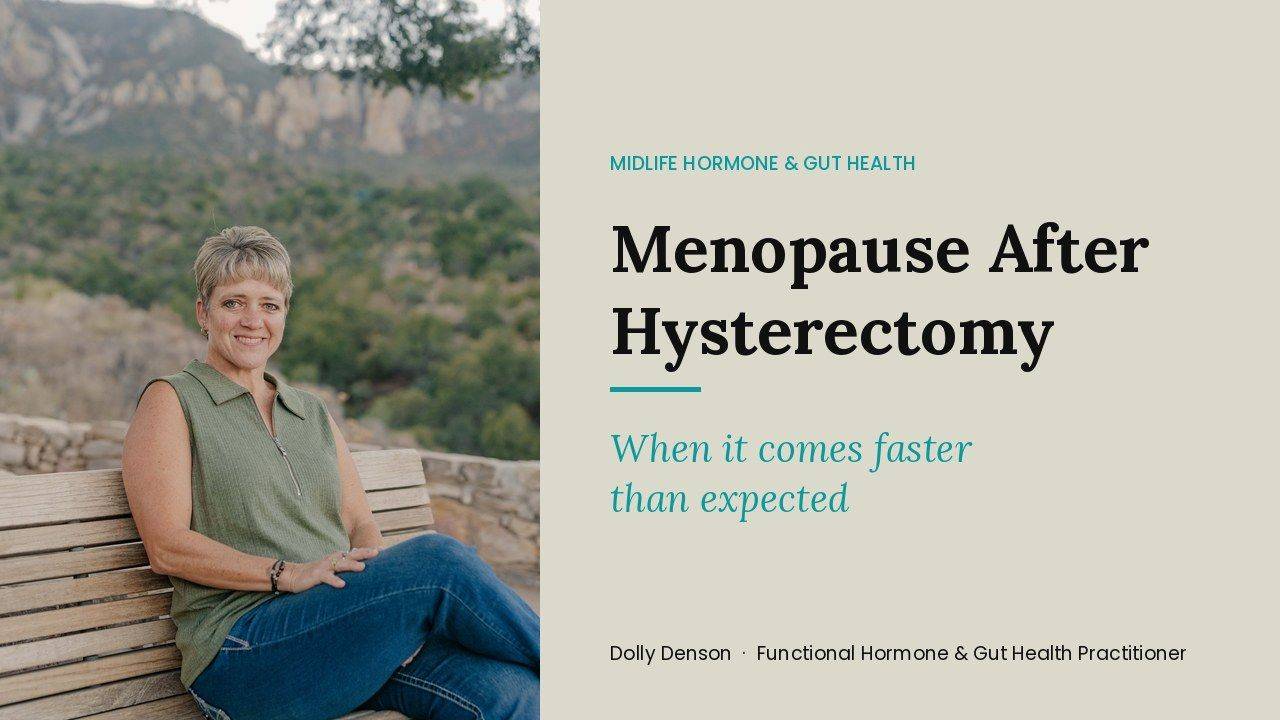
In 2024, I had a hysterectomy I didn't see coming.
I kept one ovary. I was told that meant I shouldn't go into menopause.
But my body had a different story.
The strategies that had worked for me for more than a decade simply stopped working. My body felt unfamiliar, almost overnight.
And I'm a nurse practitioner. I knew the textbook. I understood menopause.
It still caught me off guard.
If you're here, maybe you know that feeling too.
Maybe menopause came earlier than you expected. Maybe your body changed quickly after a hysterectomy, even though you kept one or both ovaries. Maybe you've been told everything should be fine, yet you know something has changed.
This is what I wish someone had sat down and explained to me.
A hysterectomy doesn't always mean surgical menopause
There are a few terms worth separating (Office on Women's Health).
Premature menopause occurs before age 40.
Early menopause occurs between ages 40 and 45.
Surgical menopause specifically refers to menopause caused by removal of both ovaries. Because ovarian hormone production falls abruptly, symptoms can begin very quickly.
A hysterectomy is different.
When the uterus is removed but one or both ovaries remain, you no longer have periods, but the ovaries can continue producing hormones. Technically, that isn't surgical menopause.
But that doesn't necessarily mean ovarian function will continue exactly as it would have without surgery.
Research has found an increased risk of earlier ovarian failure after hysterectomy even when ovaries are preserved. In one prospective study, women who underwent hysterectomy while retaining ovarian tissue had nearly twice the risk of ovarian failure compared with women who did not have surgery. The risk was higher among women who retained only one ovary.
Researchers are still learning why this happens. A later study by Trabuco and colleagues found similar levels of anti-Müllerian hormone, a marker of ovarian reserve, before surgery, but a greater percentage decline one year afterward compared with women who did not have surgery. This suggests surgery may play a role, though it does not establish the cause in an individual woman.
That's an important distinction.
It doesn't mean every woman who has a hysterectomy will experience earlier menopause.
But it does mean that when a woman tells me, “Everything changed after my hysterectomy,” I don't automatically dismiss that experience simply because she kept an ovary.
I know firsthand that the story can be more complicated than that.
Sometimes there isn't much of a runway
During the natural menopause transition, ovarian hormones typically fluctuate and change over several years.
That doesn't make the transition easy. But there is often some runway.
When both ovaries are removed, that runway essentially disappears because ovarian hormone production drops abruptly (The Menopause Society).
And even when ovaries are preserved, some women experience significant changes after hysterectomy or reach menopause sooner than expected.
At the same time, the body may also be recovering from surgery, disrupted sleep, reduced movement, stress, changes in eating patterns, medications, pain, or whatever health issues led to surgery in the first place.
That's one reason I think it's too simplistic to look at every symptom through the lens of estrogen alone.
Hormones matter enormously.
But they don't operate in isolation.
What you might notice
Every woman's experience is different, but common changes around the menopause transition can include (Cleveland Clinic):
- disrupted sleep or waking during the night
- hot flashes or night sweats
- changes in energy
- changes in body composition or weight
- increased anxiety, irritability, or feeling emotionally “flat”
- brain fog or difficulty concentrating
- vaginal dryness or discomfort
- changes in sexual desire
- urinary symptoms
Some women also notice that digestion changes during this season (The Menopause Society).
Bloating, constipation, reflux, food tolerance, or bowel patterns may feel different than they did before.
Research into menopause and gastrointestinal health is still developing, but there is growing interest in how changes in ovarian hormones interact with gastrointestinal function, motility, the gut microbiome, and hormone metabolism.
That doesn't mean every digestive symptom is caused by menopause.
It means digestion is another part of the whole-body picture worth paying attention to rather than automatically separating it from everything else.
And symptoms that are new, persistent, severe, or concerning should always be discussed with your healthcare provider so other causes can be evaluated.
My experience changed the questions I started asking
Initially, I did what many women are encouraged to do.
I tried hormones.
And for me, I didn't feel better. I felt worse.
That doesn't mean hormone therapy is bad, and it certainly doesn't mean my experience will be yours.
Hormone therapy can be an important option for many women. And when menopause occurs prematurely or early, or after removal of both ovaries before the usual age of menopause, the conversation isn't only about symptom relief. The potential effects of prolonged estrogen deficiency on bone, cardiovascular, and other aspects of health also deserve consideration with a knowledgeable healthcare provider.
But my own experience made me realize that I needed to ask a bigger question.
Not simply:
“What are my hormone levels?”
But:
“How is my body responding to this hormonal shift?”
That question changed the way I looked at my own health.
And eventually, it changed the way I approached my work with women.
Hormones are part of a much bigger system
Once I started looking more deeply, I began seeing patterns I hadn't understood before.
I looked at glucose and insulin regulation, sleep and circadian rhythms, stress physiology, nutrient status, digestion and my gut microbiome, inflammatory patterns, and body composition and muscle. Eventually, genetics added another layer of context.
Testing gave me more information about my individual physiology and patterns, rather than one diagnosis that explained everything.
That information helped me understand what might be contributing to my weight resistance and how my other symptoms might fit into a larger picture. It also helped me see why replacing hormones hadn't been the whole answer for me.
That's an important part of the way I work today.
I'm interested in hormones. But I'm just as interested in the body those hormones are operating in.
Looking deeper doesn't mean rejecting hormone therapy
Hormone therapy can be a helpful tool. Nutrition, strength training, sleep, gut health, stress physiology, and medical evaluation also deserve attention. Sometimes testing adds useful information.
The question I come back to is:
What does this particular woman need?
And what information would help us understand that more clearly?
I don't diagnose or prescribe in my wellness work, and this work doesn't replace medical care.
My role is to help women recognize patterns, understand their physiology more deeply, and make thoughtful decisions about their health and the care they pursue.
Before another fix, I start with foundations
When your body suddenly feels different, it's easy to start collecting solutions.
Another supplement.
A new diet.
Longer fasting.
More cardio.
Less cardio.
A wearable.
A reset.
A new hormone protocol.
Sometimes those tools have a place.
But before adding more, I want to understand the patterns we're already seeing.
That's why I start with five foundations.
1. Your Light Environment
Your circadian system helps coordinate sleep-wake timing, metabolism, hormone signaling, and many other daily rhythms. Light is one of its strongest environmental signals.
2. Your Eating Rhythm
Food isn't only nutrients. Timing, consistency, protein, fiber, meal composition, and your individual glucose response can all provide useful information about metabolic resilience.
3. Your Digestion & Gut
Digestion, nutrient absorption, elimination, the microbiome, and aspects of hormone metabolism can intersect in important ways. Persistent changes here can be useful information rather than something to simply silence.
4. Stress & Restoration
Stress isn't only emotional. Surgery, poor sleep, under-fueling, overtraining, illness, pain, and major life changes all create physiological demand. Recovery matters too.
5. Sleep & Recovery
Sleep affects nearly every system we're trying to support, including glucose regulation, appetite signaling, recovery, cognition, and metabolic health.
The goal isn't to perfect all five.
It's to recognize your patterns and ask:
Where might my body need more support right now?
That's a very different starting point from trying another generic menopause solution.
Your symptoms are information
One of the biggest things my own experience taught me is that a symptom doesn't always tell us exactly what the solution should be.
Weight gain doesn't automatically tell us which diet you need.
Fatigue doesn't automatically tell us which supplement you're missing.
Poor sleep doesn't automatically mean you need progesterone.
Bloating doesn't automatically mean you need a gut protocol.
Symptoms give us information.
Then we look for patterns.
Sometimes that means starting with the foundations.
Sometimes it means talking with your medical provider.
Sometimes it means looking deeper with testing.
And sometimes it means doing several of those things together.
Your body has been through a significant change. What you're noticing deserves curiosity rather than dismissal.
Not sure where to start?
That's exactly why I created the Midlife Pattern Snapshot.
It's a short, free quiz designed to help you step back from all the menopause noise and look at your own daily patterns.
Instead of giving you another list of things to do, it points you to one foundation that may be worth paying attention to first.
Take the Midlife Pattern Snapshot →
And if you already know you want to look deeper at what's changed, particularly after surgery, an earlier-than-expected menopause transition, or years of feeling like you're doing everything right without getting answers, you can also apply for a complimentary Connection Call.
We'll talk about what you've been experiencing, where you feel stuck, and whether my approach is the right fit for what you need.
You don't need another generic menopause checklist.
Sometimes you need a better way to understand the patterns your body has been showing you.
Sources
- Moorman PG, Myers ER, Schildkraut JM, et al. Effect of hysterectomy with ovarian preservation on ovarian function. Obstetrics & Gynecology. 2011.
- Trabuco EC, Moorman PG, Algeciras-Schimnich A, Weaver AL, Cliby WA. Association of ovary-sparing hysterectomy with ovarian reserve. Obstetrics & Gynecology. 2016;127(5):819–827. doi:10.1097/AOG.0000000000001398. Summary: Ovary-sparing hysterectomy may accelerate menopause onset, Medscape.
- Office on Women's Health. Early or premature menopause.
- Cleveland Clinic. Premature and early menopause.
- The Menopause Society. Surgical menopause causes more severe genitourinary syndrome of menopause phenotype. 2026.
- The Menopause Society. Digestive health issues more common during perimenopause and menopause. 2025.
Dolly Denson, FNP-BC, is a Functional Hormone & Gut Health Practitioner. This article is for educational purposes only. It is not medical advice and does not diagnose, treat, or replace care from your healthcare provider. Please talk with your healthcare provider about symptoms, medical conditions, medications, hormone therapy, or changes to your healthcare.
Not sure where to start?
Take the free Midlife Pattern Snapshot and find one foundation to focus on first.

Dolly Denson
Functional Hormone & Gut Health Practitioner
Hi, I'm Dolly. I'm a nurse practitioner (FNP-BC) and Functional Hormone & Gut Health Practitioner. I help women in midlife understand what's changed in their bodies, notice their patterns, and find a clear place to start.
Looking for the podcast?
My earlier podcast, The Be That Mom Movement, and its digital safety resources for families are still available.